
How to Decode Any Job Description and Prove You’re the Solution

Note: In this article, the terms CV and résumé are used interchangeably. While different regions may prefer one term over the other (e.g., “CV” in the UK/EU and “résumé” in the US), both refer to the same document: a summary of your professional experience, education, and skills.
Stop listing duties. Start proving value.
If you’ve ever felt the demoralizing silence after applying to dozens of jobs, you’ve likely asked yourself the same questions…Why am I not hearing back? Is something wrong with my résumé? Am I even qualified? It’s a frustrating cycle that can make even the most accomplished professional question their experience. The problem isn’t your qualifications; it’s your approach.
The single most significant mistake candidates make, is writing a CV that reads like a historical record of their job duties. It lists tasks and responsibilities, but it fails to answer the only question the hiring manager truly cares about.
“Can you solve my problem?”
This is the central thesis of this entire guide. You must prove you are the solution.
A job description is a detailed outline of a business’s “pain points.” Every line item, from “manage social media channels” to “streamline operational workflows,” represents a problem that is costing the company time, money, or market share. They need a solution, and that solution is a person.
This guide provides a step-by-step framework for understanding how recruiters and hiring managers think, deconstructing any job description to uncover its core business problems, and building a master résumé that proves you are the solution they’ve been looking for. This shift in perspective is the key to moving to the top of the interview list.
Can you solve my problem?

Before you write a single word, you must understand the psychology of the person on the other side of the screen. Hiring is fundamentally an exercise in risk mitigation. Hiring managers and recruiters can be overworked, behind on deadlines, and now have the added pressure of filling a critical role.
Their primary goal is to find the most dependable and immediately effective candidates, someone who can step in and solve problems without creating new ones.
To understand what makes a candidate dependable and immediately effective, you need to think like a hiring manager. Zoom out and look at the business the way they do. Every role, every task, and every hire must connect back to the growth of the business and the basic drivers of profit.
Thinking like a business owner
The most successful candidates approach an interview as a business partner, not just a job seeker. They understand that every job exists to solve a problem.
The key to positioning yourself as the safe choice lies in analysing the job description. Every responsibility listed is a proxy for an underlying business need. Your role is to diagnose these needs and position your experience as the solution.
To do this, you need to understand one thing: every business goal ties back to profit.
At the heart of every business is a simple formula.
Profit = Revenue Less Costs
That is the foundation of business. Every job, regardless of title or industry, connects to one of three goals:
| Increase Revenue | Reduce Costs | Improve Efficiency |
|---|---|---|
This includes anything that brings money into the business:
Any action that helps money come in contributes to revenue |
This includes anything that prevents unesscesary losses:
Cost reduction protects profit just as strongly as revenue does. |
This includes anything that makes operations run smoother:
Efficiency improvements compound over time. |
It does not matter if you work in customer support, compliance, marketing, payments, risk, HR, product, or operations. Every role in iGaming supports one or more of these goals. Once you understand this, you start seeing your tasks differently.
| Role | Example |
|---|---|
| Customer Support | Prevent churn → increase revenue Reduce repeated tickets → reduce costs Faster handling → increase efficiency |
| Payments / Fraud | More successful deposits → increase revenue Catch fraud → reduce costs Fewer manual reviews → increase efficiency |
| CRM | Higher conversions → increase revenue Fewer complaints → reduce costs Automated journeys → increase efficiency |
| Compliance | Faster player onboarding → increase revenue Fewer fines → reduce costs Faster KYC → increase efficiency |
The job description decoder framework
Every job description lists duties. Your job is to look past them and ask: what’s the real business problem here?
This framework helps you do that. For each responsibility listed, work through four questions:
| What the job description says | The real problem | What good looks like | What evidence you can show |
|---|---|---|---|
| What’s the literal duty in the job description? | What goes wrong if this is done poorly? | What would someone great at this actually do? | What evidence do you have that you’ve done this? Tangible examples, metrics, or achievements a candidate could highlight that prove they can solve the real problem. |
Example: Customer Support Agent (iGaming)
Let’s deconstruct a real-world job responsibility using the framework. For this example, we will analyze the role of a Customer Support Agent at an iGaming operator, focusing on a single duty from the job description: “Respond to player queries via live chat and email.”
- Step 1: Isolate the core responsibility. The job description duty states: “Respond to player queries via live chat and email.”
- Step 2: Diagnose the business risk. Ask yourself: what goes wrong if this is done poorly? Think lost revenue, frustrated players, compliance risk, operational bottlenecks. This is what the business cares about.In this case, slow or unclear responses frustrate players, increase repeat contacts, and drive churn—costing the business revenue.
- Step 3: Define what good looks like. What skills, knowledge, or capabilities would make someone great at solving this problem?
In this case: strong product knowledge (games, bonuses, wagering rules), familiarity with promotions, T&Cs and payment systems, clear written communication, and the ability to troubleshoot issues without unnecessary escalation. The outcome: fast, accurate responses that resolve issues first time and keep players satisfied. - Step 4: Link your experience as the solution. This is where you connect your past accomplishments directly to the business’s needs. Instead of just listing skills, you provide specific, relevant proof. Use metrics or outcomes that show you’ve solved this problem before. Example: “Maintained 94% first-contact resolution across 150+ daily chats, reducing repeat contacts by 22%.”
How to write bullet points that prove your value
Step 4 asks for proof. But how do you write it? Numbers are the universal language of business, and your fluency is a direct signal of your value. This is where you make your case and prove you are the solution. The best structure for this is the AMR (Action, Method, Result) structure.
Action: What you did.
Method: How you did it.
Result: What changed (measured in numbers).
Numbers are non-negotiable. Use percentages, dollar amounts, time saved, or volume handled. Companies need to see that you moved a metric, not just performed a task.
Weak: “Handled customer queries via live chat.”
Strong: “Maintained 94% first-contact resolution across 150+ daily chats, reducing repeat contacts by 22%.”
Same job. One describes the duty. The other proves value.
| What the job description says | The real problem | What good looks like | What evidence a candidate can show |
|---|---|---|---|
| Handle player complaints and escalations | Unresolved complaints lead to negative reviews, chargebacks, and regulatory risk, damaging revenue and reputation | De-escalation skills, knowledge of responsible gambling protocols, ability to resolve issues with appropriate compensation | “Resolved 85% of escalations without supervisor intervention, maintaining 4.2/5 player satisfaction rating” |
You now have the raw material including clear problems, real solutions, quantified proof. The next step is to package it so a hiring manager can absorb it in seconds.
Assembling your Master CV
Now that you’ve uncovered the business needs behind the role and translated your experience into evidence, the next step is packaging all of this into a CV structure that highlights your value immediately. This is where presentation and clarity matter just as much as content.
The Professional Summary is the perfect place to proactively address any potential questions or “risks” on your résumé. Use this one or two-sentence to bridge a title gap, explain a career pivot, or provide context for a layoff. It should directly connect your core expertise to the specific needs of the role.
Next, ensure your document is built for a human who is skimming.
Follow these non-negotiable formatting rules:
- Simplicity is Key: Avoid complex templates, graphics, columns, or tables. Some applicant tracking systems, like Workday, cannot properly parse multi-column layouts, and visual clutter only makes it harder for a human reader to find what matters.
- Clean and Consistent: Use standard, readable fonts like Arial or Calibri. Ensure headings, spacing, and bullet point styles are consistent throughout the document to create a polished, professional look.
- Focus on the Recent Past: Your most relevant proving ground is the last 5-7 years of your experience. Prioritize this section with your most detailed, impactful bullet points. Condense older, less relevant experience to a few key achievements or job titles.
Everything you’ve built up to this point forms your Master CV, your complete, fully developed bank of achievements, impact statements, and business-focused proof. This version exists so you can tailor your applications quickly and strategically.
Tailoring your Master CV
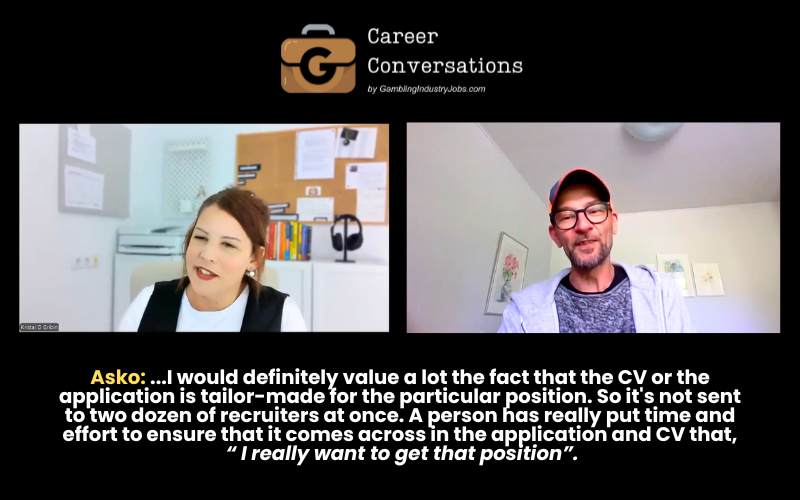
Once your Master CV is complete, the final step is tailoring. A generic résumé is a rejected résumé. For each application, place your résumé and the job description side-by-side. Look for key phrases and priorities in the posting and thoughtfully pepper them into your résumé. This is about mirroring language for a human reader to show a clear and immediate fit.
By following these steps, you have successfully transformed your resume from a simple historical document into a targeted, compelling sales proposal for your candidacy.
If you want to take this strategy even further, the next step is preparing a simple 30 day plan that shows how you would hit the ground running. However, this is usually done when you are invited to an interview.
What hiring managers look for
Even the strongest CV is only one part of the story. From dozens of Career Conversations with iGaming hiring managers, one thing became clear: they evaluate the whole person, not just the document.
- Your Online Presence: Hiring managers look at LinkedIn, and for social or creative roles they may also check Instagram or TikTok. They are trying to understand who you are. Will you fit in their team?
- Your Interests & Hobbies: Several hiring managers told me they read the interests section first. Unique or specific hobbies help them picture you on their team and make you more memorable. Side projects, part-time roles, or volunteer work also stand out because they show character and work ethic.
- Authenticity Matters: Don’t sound like ChatGPT. Hiring managers can instantly detect when a CV was written entirely by AI. They want your real voice and consistency between how you write and how you speak.
- Your Cultural Contribution: Hiring managers look for more than technical ability. They want positivity, curiosity, emotional maturity, and someone who contributes to team energy. Even small examples of improving processes, sharing knowledge, or supporting teammates carry weight.
- Your Effort: As one hiring manager put it: “If the CV looks outdated, I assume they haven’t tried.” Modern formatting, clean layout, and tailoring your application show respect for the role.
If you want the full, unfiltered insights from these hiring managers, you can read the full article here.
Frequently Asked Questions
The real business problems behind a job description are revealed by looking beyond the listed tasks and understanding why each task exists. Every responsibility in a job posting represents a pain point related to revenue, costs, or efficiency. By asking “What goes wrong if this isn’t done well?” you uncover the true business need. This approach allows you to position your experience as the solution to specific operational or financial challenges within the company.
Hiring managers are focused on risk mitigation. They want candidates who can step in and solve problems without creating new ones. A list of duties doesn’t tell them whether you increased revenue, reduced costs, or improved efficiency. Demonstrating business impact proves you understand how your work supports the company’s goals and shows you can deliver measurable results quickly, which makes you a more dependable and effective hire.
The Job Description Decoder Framework helps you translate surface-level job duties into a clear map of business needs, ideal performance, and proof of your ability to deliver results. It moves you from listing what you’ve done to demonstrating how your actions solved problems. By breaking each responsibility into the duty, problem, ideal solution, and evidence, you create achievement-driven content that becomes the backbone of a strong Master CV.
The AMR method (Action, Method, Result) turns passive statements into quantified, high-impact achievements. It clearly explains what you did, how you did it, and what changed because of your efforts. This structure highlights your ownership, decision-making, and measurable outcomes. AMR bullet points allow hiring managers to quickly see the value you created and how it ties directly to revenue, cost reduction, or efficiency improvements.
A Master CV is your complete library of achievements, impact statements, and business-focused proof. It contains all variations of your strongest bullet points, summaries, and accomplishments. A tailored CV is a curated version built from the Master CV and customised for a specific job. Tailoring involves selecting the most relevant achievements and mirroring the language of the job description to demonstrate immediate fit for one particular role.
Tailoring is essential because hiring managers can instantly recognise a CV sent to multiple companies. Customising your CV shows effort, respect, and a genuine interest in the role. By aligning your language with the job description and highlighting the achievements that match the employer’s priorities, you make your value immediately clear. Even a strong Master CV must be tailored for maximum relevance and impact.
Every job ultimately supports one or more drivers of profit: increasing revenue, reducing costs, or improving efficiency. When you frame your achievements within these categories, you demonstrate that you think like a business partner, not just an employee. This mindset allows you to present your work in terms of measurable outcomes, making your CV more compelling to hiring managers who are responsible for performance and results.
iGaming hiring managers look at online presence, authenticity, communication style, cultural contribution, and overall effort. They check platforms like LinkedIn to understand your tone and personality. They read interests and hobbies to visualise team fit. They assess whether your writing is clear and human rather than overly AI-generated. Modern formatting and tailored applications also signal motivation and professionalism.


