
8 Steps for iGaming Job Hunting in an Employer-Driven Market
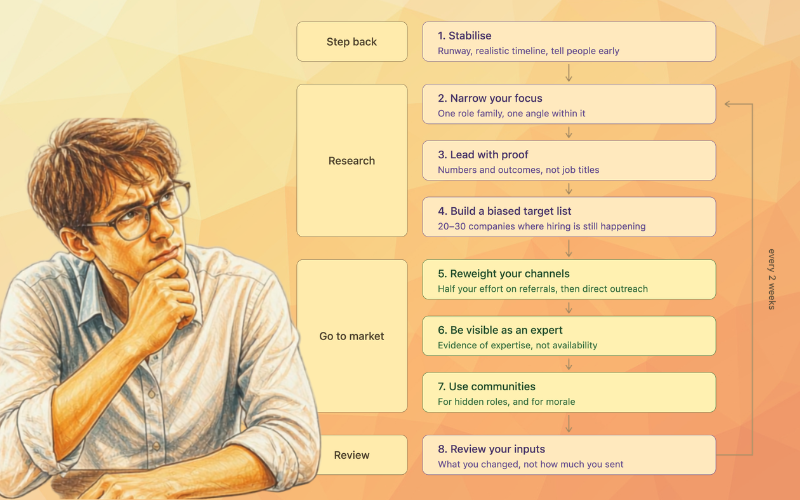
The iGaming job market has changed. Thousands of people across operators, suppliers and affiliates have been made redundant. Hiring has slowed. Roles that would have attracted forty applicants two years ago are now attracting four hundred. If you’re in the middle of this and wondering why the approach that worked last time isn’t working now, the answer is… the market flipped.
In my Career Conversations series I speak to hiring managers looking for their next standout hire, and to professionals who’ve navigated redundancies, pivots and re-entries themselves. What’s come up again and again recently is that people are working incredibly hard at their job search and getting nowhere, because they’re applying the tactics of a candidate-driven market to an employer-driven one.
This article is about what changes, and what to do instead.
What an employer-driven market means
A candidate-driven market is one where talent is scarce. Companies compete for you, recruiters chase you, and counter-offers are common. That’s the market iGaming enjoyed for most of the last decade.
An employer-driven market is the opposite. Candidates outnumber open roles, so employers hold the power. They can take longer, ask for more, pay less, and still fill the position. Nothing about that is a reflection on you.
The practical consequence is that in a candidate-driven market, activity is usually enough. Send enough applications, speak to enough recruiters, and something lands. In an employer-driven market, activity stops correlating with progress. You can send two hundred applications and hear nothing back, not because you’re not good enough, but because you’re the hundred-and-eightieth CV in a pile that a hiring manager stopped reading properly at number twenty.
Clarity over volume was always good advice. Now it’s the only advice that works.
8 Practical steps for a tougher iGaming market
1. Stabilise before you strategise
Before you touch your CV, work out three things. How many months of runway do you actually have. What your realistic timeline is. And who you’re going to tell.
On timelines, be generous with yourself. Six to nine months is a normal search in this market for a mid-to-senior role. That isn’t failure, it’s the current average, and knowing it in advance changes how you behave. People who expect six weeks and get twelve start panicking around week seven, and panic produces exactly the scattergun applications that don’t work.
Tell people early, too. Redundancy in iGaming right now is so widespread that the stigma has largely evaporated, and the people who move fastest are usually the ones who said out loud what they were looking for in week one rather than week ten.
2. Narrow your focus
Every instinct tells you to widen the net when roles are scarce but this is the wrong move.
When a hiring manager has four hundred CVs, they aren’t looking for the most versatile person, they’re looking for the fastest reason to say yes, which means the person whose experience maps most obviously onto the problem in front of them. A CV that says “CRM, affiliates, and a bit of product” loses every time to one that says “CRM retention for sportsbook in regulated LatAm markets.”
So get specific in two dimensions:
- Role family: Not marketing > CRM. Not commercial > Affiliate partnerships.
- Angle within it: A vertical, a market, a regulatory environment, a product type. Something that makes you the obvious answer to a narrow question rather than a reasonable answer to a broad one.
Yes, this means you’ll apply for fewer roles. That’s the point. Ten well-targeted applications where you’re visibly the right shape will outperform a hundred where you’re plausible.
3. Lead with proof
In a crowded pile, job titles stop differentiating you, because everyone else in the pile has them too. There are a lot of very good CRM Managers looking for work right now.
What separates you is evidence. Numbers, outcomes, things that happened because you were there:
- Retention or reactivation rates you moved, and by how much
- Cost per acquisition you brought down
- A market you took from licence application to launch
- A migration, a platform integration, a team you built
- Revenue, deposits, or LTV you can attribute to something you did
If you can’t remember the numbers, go and find them. Old decks, old reports, former colleagues. It’s worth a weekend of digging, because a CV built on responsibilities reads like a job description, and a CV built on outcomes reads like a solution.
Build this into your Master CV first, then tailor from it. The tailoring step still matters, but it’s much easier when the underlying material is strong.
4. Build a target list, and bias it towards where hiring is happening
A shortlist of companies is standard advice. What’s changed is that the shortlist needs to be weighted, not just compiled.
Not everywhere in iGaming is contracting at the same rate. When you build your list of twenty to thirty companies, lean deliberately towards:
- B2B suppliers over B2C operators. Platform, payments, content, compliance and data businesses have generally held up better than consumer-facing brands.
- Growth markets over saturated ones. Brazil, parts of Africa, individual US states and newly regulating European markets are still building teams. The Malta, Gibraltar and Cyprus corridor is where the largest concentration of displaced candidates currently sits.
- Companies that just won a licence, launched a product, or took investment. These are the ones that will be hiring in three months, which is roughly when your application will matter.
This is research, and it’s the part of the job search most people skip because it doesn’t feel like progress. It is progress. Everything in steps two, three and five depends on it.
If you want a starting point, I’ve compiled lists of iGaming B2C companies and B2B companies, including office locations, so you can build your shortlist without starting from a blank page.
5. Reweight your channels
There are four ways into a role: referrals, direct outreach, recruiters and job boards. In a candidate-driven market they all work reasonably well. In an employer-driven market their yields diverge sharply, and most people spend the majority of their effort on the two that have got weakest.
Referrals should now be roughly half your effort. The industry is small and people move constantly. A referral doesn’t have to come from a close friend, it just has to come from someone inside the company, because an internal recommendation moves you out of the pile and onto a desk. It also reduces the employer’s risk, which is exactly what employers optimise for when they have options.
Direct outreach to named hiring managers is the second priority. Not a recruiter, not an HR inbox. The person who owns the problem. A short, specific message referencing something real about their business will get read far more often than an application form.
Specialist iGaming recruiters are excellent, and they know the landscape better than anyone, but they work for the employer and right now they have a queue. When a recruiter has two hundred qualified candidates for one role, they’re filtering, not advocating. Keep two or three you trust, stay responsive, but don’t let “I’ve registered with agencies” count as your job search.
Job boards are where you do your research, and where you apply second. Here’s the distinction that matters. Cold applications through any board are the lowest-conversion action available to you, on any board, anywhere. But that’s an argument about applying, not about using.
A job board is the single best source of live market intelligence you have. It tells you which companies are hiring and which have gone quiet. It tells you which markets are expanding. It shows you, across dozens of live listings, exactly which skills, tools and KPIs are being asked for in your role family right now, which is the raw material for your Master CV and your target list.
Read boards like a market analyst, not like a form-filler. Set alerts so you see roles early, because in this market being among the first fifty applicants genuinely matters. Then apply to the ones where you’re a strong fit, and use every other listing as research.
On GamblingIndustryJobs.com we actively gather roles from operators, suppliers and affiliates, and companies can list up to five jobs for free, which means smaller and earlier-stage roles often appear here that won’t surface on the large generic platforms.
6. Be visible as an expert, not as a jobseeker
Recruiters and hiring managers search LinkedIn before they shortlist. If they can’t find you, or they find a profile that says nothing beyond your job titles, you’re not in the conversation.
Broadcasting availability worked better when there were fewer people broadcasting. Now, what gets attention is evidence of expertise. One useful post a fortnight about your specialism, a thoughtful comment on someone else’s, a short breakdown of something you’ve learned about a market you know well. Not daily content, or becoming an influencer, just leaving a visible trail that proves you know your subject.
On the “Open to Work” banner, the argument against it used to be noise, and that argument has weakened considerably, because there are fewer recruiters doing outbound. Use it if you know exactly what you’re targeting and you’re ready to engage. It costs you very little now.
7. Use communities, for leads and for morale
Plenty of roles never reach a careers page or a job board. They get mentioned in a LinkedIn group, a Slack channel, a country-specific Facebook group, or a WhatsApp thread between people who used to work together. Customer support, affiliate, early-career and contract roles especially.
Join the communities relevant to your market and your role family, and be visible in them. Comment, answer questions, share what you know. Recruiters and hiring managers read these spaces even when they’re not posting in them.
But communities matter for something beyond leads.
Redundancy is isolating, and it’s particularly isolating in an industry where LinkedIn makes it look like everyone else is still moving forward. They’re not. There are a lot of people in exactly your position right now, sharing contacts, making introductions, and reminding each other that this is a market condition rather than a personal verdict.
“In my current experience, I’ve used my network and I found that there’s a circle of us who are redundant and we’re just putting our heads together… We’re sharing and exchanging contacts, recommendations. We’re hanging out to go and do yoga in the morning… It gives another extra support knowing that you’re in the same boat somehow” – Faye Haridas
8. Review your inputs, not your outputs
Set a fortnightly review, and make it about what you changed rather than how much you sent.
Did you get a referral into any target company. Did you speak to a human being at one. Did your positioning get sharper. How many of your applications were to roles where you were visibly the obvious candidate, rather than a reasonable one.
If six to eight weeks pass with no interviews, the answer is not to send more but to change an input such as the targeting, the positioning, the channel mix, or the proof on your CV. Sending the same thing to more people faster is the single most common way to burn three months in a difficult market.
The uncomfortable part
In a market with more candidates than roles, good people with strong records will apply for jobs they’d have walked into two years ago and hear nothing. That will happen to you at some point in this search, and it will not be a reflection of your ability.
What you control is the quality of your targeting, the strength of your evidence, and the number of real human conversations you have with people inside the companies you want to work for. Those are the variables that move the odds. Everything else is noise.
Conclusion
The iGaming market will turn again. Licences keep being issued, new markets keep regulating, and the industry has never stayed still for long. But you have to get through the current one, and the way through it is not to work harder at tactics designed for a different market.
Get stable first, get specific, prove what you’ve done with numbers and research properly, so you know where the hiring actually is. Spend your effort on referrals and real conversations rather than application forms. Stay visible as someone who knows their subject. And do not do it alone, because the people who come through these periods well are almost never the ones who went quiet.
Careers in iGaming are rarely linear. This stretch is harder than most. It’s still navigable, and it’s considerably more navigable with a plan than without one.
FAQs
An employer-driven market is one where there are more qualified candidates than open roles, which means employers set the terms on pay, process and timelines. A candidate-driven market is the reverse, where talent is scarce and companies compete for it. iGaming has moved from the second to the first, which is why job search tactics that worked two years ago are producing worse results now.
For mid-to-senior roles, six to nine months is a realistic planning assumption in the current market. Some people move much faster, particularly with a strong referral, but planning for six weeks and budgeting accordingly is the most common source of avoidable stress.
Generally no. Broadening makes you a plausible candidate for many roles rather than the obvious candidate for a few, and in a deep applicant pool the obvious candidate wins. Narrow your role family and your angle, then consider broadening by geography or by adjacent industry instead.
Yes, but as one channel among four rather than your main strategy. Recruiters work for the employer, and when they have a large pool of qualified candidates for each role they function more as a filter than an advocate. Keep two or three specialists who know your vertical, be responsive, and make sure the majority of your effort goes into referrals and direct outreach.
Job boards are most valuable as market intelligence. Live listings show you which companies are hiring, which markets are expanding, and exactly which skills and KPIs are being asked for in your role family, which is what your CV and target list should be built from. Apply to the roles where you're genuinely a strong fit, set alerts so you see them early, and use everything else as research.
Look for second-degree connections, former colleagues who have since moved there, and people who've worked at your previous employers. A referral doesn't require a close relationship, only someone willing to pass your name internally. Asking for a short conversation about what the company is like is usually a better opening than asking directly for a referral.
Broadly, B2B suppliers have held up better than B2C operators, and newly regulating or high-growth markets are recruiting while mature markets consolidate. Companies that have recently won a licence, launched a product, or raised investment are the most likely to be building teams in the next quarter.
More easily than most people assume. Payments, affiliate marketing, fintech, B2B SaaS and regulated consumer tech all value the same core skills, particularly around compliance, retention, acquisition economics and operating in licensed environments. Treating two or three adjacent sectors as a genuine hedge is sensible in a contracted market.
Structure and community are the two things that reliably help. A fortnightly review focused on what you changed gives you a sense of progress that application counts don't, and staying connected to others in the same position removes the isolation that makes a long search harder than it needs to be.


