
Transferable Skills for iGaming Jobs: How to Get Hired Without Gaming Experience

The iGaming world has a reputation for being tough to enter, almost like an exclusive club where only people with “industry experience” get a foot in the door. Jobseekers often assume that if they haven’t worked for an online casino or sportsbook before, they’re automatically at a disadvantage. The reality is the opposite.
Behind the scenes, hiring managers aren’t only searching for people who already understand RTPs, CRM tools, or affiliate tracking platforms. They’re looking for people who bring fresh thinking, strong foundations, and transferable skills from completely different industries. Some of the most successful professionals in iGaming didn’t start in gaming at all, they came from hospitality, retail, journalism, law, healthcare, finance, education, and even sports.
What matters most isn’t where you’ve worked before but how you think, solve problems, collaborate, and learn.
This article breaks down the essential transferable skills that make candidates stand out in gaming roles across marketing, operations, product, data, compliance, customer experience, and more. It also shows why your unique background is often your biggest competitive advantage, and how to position those strengths when applying.
If you’re exploring the industry for the first time, pair this guide with the full breakdown in How to Break Into the Gambling Industry, where you’ll find detailed entry paths, role overviews, and the ecosystem of the Gambling Industry in general.
Sometimes, mindset matters more than iGaming experience
Long before hiring managers look at someone’s technical skills or past titles, they’re scanning for something deeper, the mindset. In an industry that moves quickly, adapts constantly, and thrives on experimentation, the way a person thinks often matters far more than whether they’ve worked in gaming before. These core attitudes are the true predictors of whether someone will excel once they’re inside the industry.
Curiosity, creativity, and hunger to learn
iGaming companies operate in a high-speed environment where tools, regulations, market trends, and player behaviour shift all the time. Because of this pace, employers place a premium on people who are naturally curious and eager to learn.
Curiosity signals that someone won’t just follow instructions; they’ll explore, question, and understand why things work the way they do. Creativity shows up in how someone approaches challenges, campaigns, or even player problems. And a hunger to learn is what enables newcomers from outside the industry to ramp up quickly and outperform more “experienced” hires. Andrei Buta, Co-founder of SkyControl, articulates this perspective perfectly:
“What matters most is curiosity, creativity, and the hunger to learn. So we can teach the industry specific stuff. But the mindset is harder to train, you know.
These qualities can’t be forced, and they’re almost impossible to teach. That’s why hiring managers treat them as gold.
Problem-solving: turning chaos into opportunity
Every department in iGaming is built on ongoing challenges. Fraud patterns shift. Campaigns underperform. Regulations change overnight. A feature breaks right before a launch. The companies that grow the fastest are the ones with teams full of people who troubleshoot.
Problem-solvers aren’t overwhelmed by the pace; they see patterns, ask the right questions, and experiment with solutions.
In practical terms, this mindset is equally valuable for a CRM executive adjusting a campaign, a payments agent spotting suspicious activity, or a marketing manager trying to improve conversions. This ability to navigate complexity separates the people who survive the industry from the people who thrive in it. When we interviewed Jacqui Gatt, who started her career as a Live Dealer and worked her way up to COO, she articulated this perspective perfectly when reflecting on her experience at the startup Beyond Play (prior to its acquisition by FanDuel):
I’m the type of person who loves fast-paced environments, I thrive on stress, I like solving complex issues, so I really, really enjoyed it.
Ambition and drive outperform experience
One of the most surprising truths about iGaming is how often the top performers started their careers without any gaming background at all. What they did have was ambition, the willingness to learn quickly, take ownership, and put energy into mastering their craft. Many founders and hiring leads openly say they prefer a motivated junior over someone experienced but comfortable. Ambition shows initiative. It shows resilience. And it drives people to constantly improve, which is essential in a growing industry where new opportunities appear weekly.
This is why so many professionals from hospitality, retail, finance, education, creative fields, and even law manage to break into gaming and rise quickly. Ambition is the engine behind most of those success stories.
Transferable hard skills every department wants
Mindset may determine your long-term trajectory, but certain practical skills make you immediately useful from day one. These transferable hard skills form the industry’s common language. Whether you’re applying for roles in marketing, operations, compliance, BI, or VIP, this “practical toolkit” helps hiring managers see your potential right away.
If you’re coming from another industry, chances are you already have most of these skills. You just need to highlight them clearly.
Excel & data literacy
If there’s one tool that appears across almost every conversation in the industry, it’s Excel. You don’t need to be an expert, but you should understand the basics of organizing data, filtering, using formulas, and interpreting what you see on the screen.
Excel is used everywhere in iGaming because the industry runs on patterns, behaviour, and numbers. Some common examples:
- Segmentation: Filtering players into groups for CRM campaigns.
- Reporting: Exporting and analysing promotion results or revenue numbers.
- VIP lists: Tracking top depositors and identifying high-value players.
- Fraud checks: Spotting unusual patterns in deposits, withdrawals, or activity.
- Affiliate management: Reviewing partner performance and EPC metrics.
- Payments & risk: Comparing transactional data for discrepancies.
In a Career Conversations interview with Robert Camilleri, BI Consultant with over 13+ years industry experience, he said:
My number one piece of advice on this one is definitely going to be Excel. It’s a numbers-based industry. I would beg everyone to have at least an intermediate level of Excel.
Excel skills demonstrate that you’re comfortable with data, which is one of the most crucial transferable strengths in the entire industry.
Analytical thinking
You don’t need to be a Data Analyst to think like one. Analytical thinking is simply the ability to look at information, identify what matters, and understand what it means for the business.
In iGaming, this shows up everywhere:
- Understanding basic KPIs such as conversion rate, retention, or NGR.
- Noticing trends in customer behaviour.
- Interpreting campaign results to understand what worked and what didn’t.
- Reviewing P&L or EBITDA figures in management or operational roles.
- Helping refine a product feature based on user feedback.
- Making data-informed decisions instead of guessing.
Even in roles like customer support, VIP, affiliate manager, CRM executive, or social media, people who understand why numbers move the way they do become far more valuable. It’s a universal skill that boosts performance in every department.
Tech comfort & tool adaptability
The iGaming industry uses a wide range of platforms and systems, from CRM tools that manage player journeys to BI dashboards that display real-time business metrics.
Some common tools used across teams include:
-
-
- CRM systems: For sending campaigns, personalizing offers, and managing player journeys.
- CMS platforms: For updating website content and landing pages.
- Ticketing systems: For handling customer issues and tracking cases.
- BI dashboards: For monitoring KPIs, player activity, and financial results.
- Affiliate platforms: For tracking commissions, clicks, conversions, and EPC.
- Fraud, AML, and payments tools: For managing checks and compliance workflows.
-
Here’s the important part: you’re not expected to know these tools before you join. What matters is your ability to pick them up quickly. If you’ve used any kind of CRM, CMS system, ticketing tool, or analytics dashboard in another industry, you already have a strong advantage.
The soft skills that accelerate your career
Technical skills can get you hired, but soft skills are what determine how far and how fast you grow. In iGaming, these human qualities often matter just as much as analytics or tool knowledge. They’re the fuel behind quick promotions, stronger relationships, and long-term career momentum.
Networking and relationship building
iGaming is, at its core, a “people-first” industry. It’s tightly connected, community-driven, and built on relationships that often span companies, countries, and even career changes. Many roles, from account management to CRM to affiliate partnerships, rely heavily on trust, communication, and rapport.
Networking is also a powerful job-search tool in this space. Many opportunities are shared internally before they ever make it to public job boards, and a good word from someone inside a company can make a significant difference.
In other words: your network is your multiplier.
Initiative: Taking on more than the job description
One of the fastest ways to stand out in iGaming is to take ownership beyond your assigned tasks. The industry grows quickly, teams evolve rapidly, and there are always new projects, tools, or features that need support. People who volunteer to help or step up when something needs to be done often find themselves gaining new skills, and new responsibilities, faster than in more traditional industries.
This willingness to contribute outside the strict job description shows leadership potential, ambition, and a commitment to the company’s success. Many of today’s managers and heads of department started in junior roles but advanced quickly because they consistently took initiative.
Adaptability: thriving in fast-paced environments
If there’s one constant in iGaming, it’s change. Regulations shift, markets open and close, technologies evolve, promotions launch unexpectedly, and priorities can change overnight. This environment rewards people who stay calm under pressure, quickly adjust to new information, and see change as an opportunity rather than a setback. Adaptability is often the trait that separates someone who simply works in the industry from someone who thrives in it.
Those who embrace the pace tend to grow faster, learn more, and become the go-to problem solvers within their teams.
Sales and persuasion: influencing decisions with confidence
Many iGaming roles rely heavily on commercial influence. Whether you’re negotiating terms with an affiliate partner, upselling features to a B2B client, or encouraging player loyalty as a VIP manager, persuasion is a key transferable skill.
People from sales, hospitality, retail, customer service, and even teaching often excel because they understand how to:
- Build rapport
- Read people
- Identify needs
- Influence decisions
- Solve objections
- Strengthen long-term relationships
These foundational sales skills transfer directly into affiliate management, business development, account management, and VIP roles.
Communication skills: the cross-department superpower
Strong communication, both written and verbal, is one of the most important skills in the industry. You’ll use it in nearly every role:
- Explaining promotions to players
- Writing clear CRM campaigns
- Presenting games on camera
- Pitching a software solution to a B2B partner
- Collaborating with colleagues across different countries and time zones
- Summarising analytical insights for decision-makers
Good communicators stand out because they make work easier for everyone around them. They help teams collaborate effectively, reduce misunderstandings, and speed up execution.
Work ethic and reliability: the qualities hiring managers trust most
Some soft skills can be taught, but work ethic, reliability, and attitude are much harder to train. iGaming companies rely on people who can:
- Show up consistently
- Handle pressure
- Maintain a positive mindset
- Follow through on commitments
- Deliver high-quality work in fast-paced environments
Hiring managers repeatedly say they prefer someone reliable and hardworking over someone experienced but unmotivated.
Why other industries give you an edge
One of the biggest misconceptions about the iGaming industry is that it only hires people with gaming experience. In reality, many companies deliberately look outside the sector for fresh perspectives and problem-solving approaches. Industries like e-commerce, fintech, hospitality, retail, and SaaS have already developed advanced practices in customer experience, digital marketing, payments, behavioural analysis, and UX. Bringing those skills into iGaming helps teams innovate instead of recycling the same ideas. As Benedict McDonagh, Head of Games for Entain Studios, explained when asked whether he’d hire people without gaming experience:
Absolutely. I want to learn from other industries to make our space better. It is a balance. You’ve got to be careful about who you have within your team already, make sure that they are there, they’re in a position to educate and train the people coming in with, you know, whatever nuances and specifics there might be within our space.
Your past career is an advantage. The skills and fresh perspectives you bring from outside the industry often spark improvements that internal teams wouldn’t have reached on their own.
Understanding where your background fits in
Below is a breakdown of common professional backgrounds that transition seamlessly into iGaming roles. Each one offers transferable strengths that hiring managers value highly.
| Your Background | Where You Can Fit in iGaming |
|---|---|
| Law → Compliance / Risk / Product | Legal professionals bring strong analytical thinking, documentation skills, and regulatory awareness — all vital for AML, licensing, and product governance. |
| Retail / Hospitality → VIP, Customer Support, Community | These fields develop emotional intelligence, service mentality, and communication — perfect for any player-facing role. |
| Journalism / PR → Content, Social, SEO, B2B Marketing | Storytelling, research, tone-of-voice mastery, and communication translate directly into content creation and brand-building roles. |
| Banking / Finance → Payments, AML, Fraud | People from finance are already familiar with risk checks, KYC processes, documentation, and transaction analysis. |
| Tech Support → QA, Product Coordination | Logical thinking, troubleshooting skills, and systems knowledge are ideal for testing and product support roles. |
| Psychology / Social Work → Responsible Gaming | Understanding behaviour and communication is invaluable for RG case handling and player protection. |
| Sales → Affiliate, Account Management, Business Development | Relationship building, negotiation, and commercial awareness are the backbone of these roles. |
| IT / Data → BI, Product, Automation Roles | Technical professionals can move into dashboards, reporting, product development, and internal automation projects quickly. |
These examples prove a consistent truth across the industry: once you understand the player and the product, your past experience becomes a powerful asset.
Transferable skills by role: A quick guide for jobseekers
If you’re new to the iGaming industry, the job titles can feel unfamiliar at first. This quick guide breaks down the most common roles and the transferable skills that make candidates stand out. Use it to identify where your experience fits and which positions align with your strengths.
| iGaming Role | Key Transferable Skills |
|---|---|
| Affiliate Manager | Relationship management, reporting and KPIs, negotiation, commercial awareness |
| CRM Executive / CRM Manager | Segmentation, copywriting, campaign planning, data analysis basics |
| Social & Community Manager | Communication, customer empathy, basic analytics, tone-of-voice mastery |
| Customer Support | Empathy, problem-solving, multitasking, tool adaptability |
| VIP Manager | Hospitality mindset, rapport building, communication, sales and conflict resolution |
| Fraud / Risk / Payments | Attention to detail, analytical thinking, pattern recognition, documentation |
| AML | Compliance mindset, research skills, process discipline |
| Data Analyst / BI | Data cleaning, KPI interpretation, Excel and SQL basics, strong business logic |
| Compliance / Responsible Gaming | Regulation awareness, case handling, ethical thinking, communication |
| Product Coordinator / QA | Problem-solving, critical thinking, testing mindset, project coordination |
| B2B Marketing Manager | Content creation, strategic thinking, brand communication, stakeholder management |
| Account Manager / Business Development | Client management, upselling, contract understanding, commercial mindset |
| Country Manager | Local market knowledge, cultural insight, operations coordination, community development |
The best roles for newcomers
Breaking into iGaming isn’t about having industry experience, it’s about choosing the right starting point. Some roles give newcomers a deep, holistic understanding of the product and the player journey, making them ideal entry paths that set people up for long-term success.
Customer support as an iGaming bootcamp
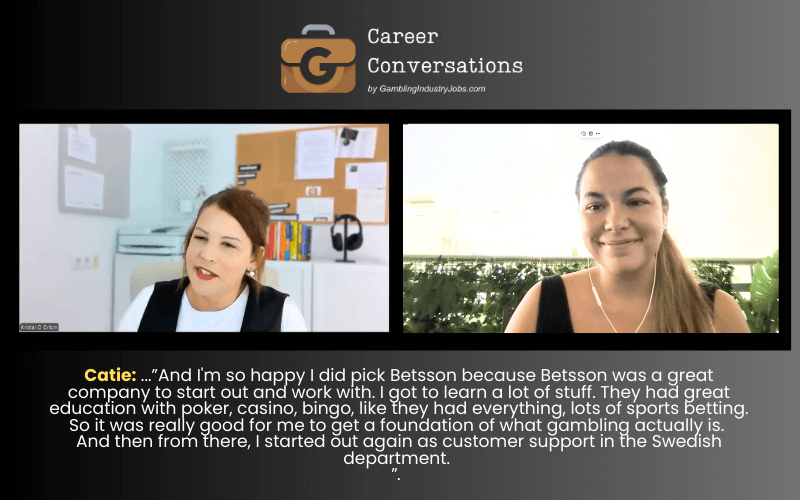
Customer Support is widely considered the smartest entry point for anyone new to the industry. It gives you a front-row seat to the most important part of the entire ecosystem: the player.
In CS, you learn:
- What frustrates users
- What excites them
- How they interact with bonuses and promotions
- How games, payments, and accounts work in practice
- What breaks, and why
- What players value most
This knowledge becomes incredibly valuable in roles like CRM, marketing, VIP, payments, product, and even compliance. Almost every senior leader in the industry agrees that understanding the player is one of the strongest foundations you can build.
Customer Support also helps you master internal tools, workflows, communication, and problem-solving, skills that transfer easily to other departments.
Live casino presenter roles
While Customer Support is often described as an iGaming bootcamp, there is another major entry route for people with no previous gaming experience: Live Casino Presenter roles offered by B2B providers.
These companies regularly hire newcomers from all kinds of backgrounds, hospitality, performing arts, retail, call centers, creative fields, or fresh graduates, because the role is built on soft skills rather than industry experience. What matters most is confidence, communication, professionalism, and the ability to present on camera.
Live presenter roles teach newcomers:
- How the live games work on a technical and operational level
- How the B2B side of iGaming functions
- How live-streamed products operate
- How player interactions and bets flow through the system
- How studios run shifts, teams, and performance metrics
- How product, risk, and operations connect behind the scenes
For many people, this is the fastest way to gain real industry exposure, understand the mechanics of casino products, and later move into roles like:
- Training & Quality
- Game Presenter Supervisor
- Studio Operations
- Player Experience
- Product coordination
- CRM (B2C operators value live gaming knowledge)
- Marketing content roles (especially around live casino)
- Payments and risk entry roles
Live presenter positions are also appealing because they don’t require previous technical knowledge. B2B training teams teach everything from scratch.
This makes it one of the most accessible pathways into the industry, especially for people coming from service-oriented or performance-based backgrounds.
What To Do Next
Turn Your Transferable Skills Into a Real Application
Now that you know which roles fit your background, the next step is to:
- Browse open roles on the GamblingIndustryJobs.com jobs board.
- Pick a few roles that match your strengths.
- Decode the job description using the job description framework.
- Rewrite your CV to highlight the transferable skills employers care about.
Final Thoughts
The iGaming industry might look intimidating from the outside, but once you break it down, you’ll see that the most valued qualities aren’t niche technical skills, they’re the transferable strengths you’ve built throughout your career. Curiosity, analytical thinking, communication, reliability, creativity, and the ability to learn fast are what truly drive success in this space.
No matter where you’re starting from, there’s a place for you in this industry. The key is understanding which roles fit your background, showcasing the skills you already have, and approaching your career transition with confidence and clarity. You don’t need years of gaming experience to get started. You just need the right mindset, and now, the roadmap. The next step is yours.
Frequently Asked Questions
Yes. Many entry-level iGaming roles do not require prior industry experience because hiring managers often look for fresh perspectives, curiosity, strong mindset, and transferable skills. Communication, reliability, analytical thinking, customer empathy, and a willingness to learn are often more important than gaming knowledge. Roles such as Customer Support, Live Dealer, junior marketing positions, data analyst roles, operations support, and multilingual positions are designed for newcomers and typically include full training.
Use the role-mapping tables in this article. They show exactly how skills from finance, retail, hospitality, sales, tech, education, and creative industries transfer into iGaming positions.
Customer Support and Live Casino Presenter roles are the strongest entry points. For both roles, reliability is absolutely essential because many teams operate on shift schedules, including evenings, weekends, and sometimes night shifts. Employers value people who show up consistently and work well under pressure.
Curiosity, analytical thinking, Excel basics, communication, adaptability, and problem-solving. For entry-level operational roles, strong work ethic and reliability are especially important, because the industry runs 24/7 and teams need people they can depend on.
Rewrite your past experience in clear, universal language, show measurable achievements, and match your strengths to the iGaming roles using the tables in this article. Don’t forget to emphasize reliability if applying for CS or shift-based roles.
Affiliate Manager, Account Manager, Business Development, and VIP roles benefit heavily from persuasion, rapport building, and relationship management.
Payments, Anti Money Laundering (AML), Fraud, Risk, BI, and Affiliate roles match perfectly with analytical thinking, attention to detail, and familiarity with financial workflows.
Content writing, SEO, Social Media, B2B Marketing, studio content, art & design, and Live Presenter roles are strong matches for storytelling, communication, and performance-based strengths.
Use the role-mapping tables in this article to identify which iGaming roles match your background. Then browse current jobs on the site using the filters to search by department or keywords. Compare each job description with your skills and refer to the job description decoding framework to tailor your application. If reliability or shift flexibility is one of your strengths, make sure to highlight it, especially for Customer Support, Payments, or other operations roles where dependable coverage is essential.


