
The $6,700 Job Application

4 Lessons from the internet’s wildest hiring stunt
The black hole of résumés
Sending a job application often feels like screaming into a void. You pour hours into crafting the perfect resume, polishing a cover letter, and tailoring your experience, only to launch it into the digital ether with a click. The response, more often than not, is crushing silence. It’s a frustrating ritual that leaves countless qualified people wondering if a human ever saw their PDF. It’s a system begging for a reboot.
One 18-year-old, in a bid to get the attention of his target company, Kalshi, decided to bypass the system entirely. Instead of submitting a document, he executed a piece of public performance art for the creator economy. He spent $6,700 on seats at a Chicago Cubs game to orchestrate a viral spectacle, turning his job application into the ultimate “proof-of-work” protocol. This story isn’t just about audacity; it offers powerful, counter-intuitive lessons for anyone trying to prove their worth in a hyper-competitive world.
The job he was targeting
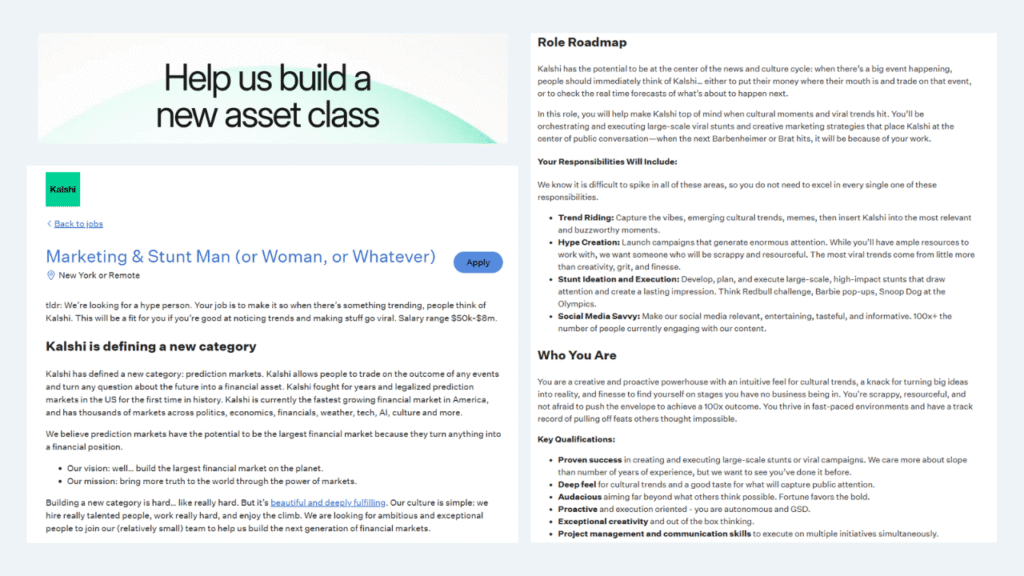
Before diving into the lessons, let’s talk about the job Morris was actually applying for, because once you read it, his entire approach makes perfect sense.
The role was called “Marketing & Stunt Man (or Woman, or Whatever)” at Kalshi, a U.S.-based prediction markets platform where users can trade on real-world events, from election outcomes to weather forecasts.
The job description didn’t read like a traditional marketing role. It was a call for creativity, boldness, and cultural instinct. Kalshi wasn’t looking for someone to manage ad campaigns or post on social media, they wanted someone who could create moments.
The brief literally asked for someone “scrappy, bold, and capable of pulling off large-scale stunts.”
Here’s what else stood out:
- Salary range: $40,000–$8,000,000 (yes, you read that right).
- Mission: Put Kalshi at the center of news and culture, so when something big happens, people instantly think of them.
- Goal: Design stunts, ride trends, and create viral moments that make the brand impossible to ignore.
In other words, Kalshi was looking for someone who could turn cultural momentum into marketing magic.
And that’s exactly what Morris did, he treated the job description as an invitation, not a checklist.
He didn’t apply for the role. He became it.
The Spark Behind the Stunt
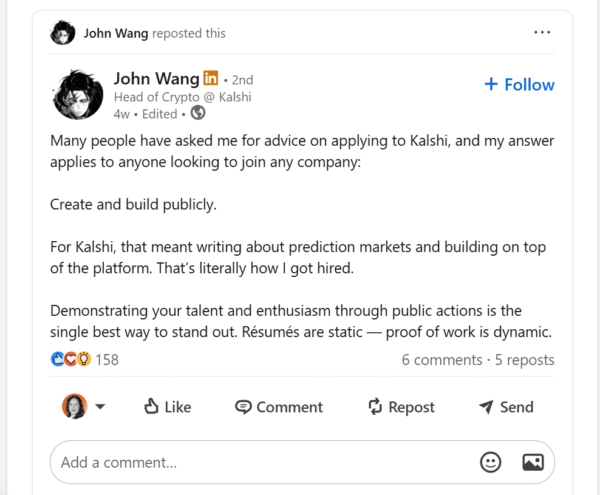
It’s worth noting that Morris didn’t come up with this idea in a vacuum. His inspiration came directly from John Wang, Head of Crypto at Kalshi, someone who had shared his own unconventional hiring story just weeks earlier.
In a LinkedIn post, Wang advised anyone applying to Kalshi to “create and build publicly.” He explained that this philosophy was how he himself got hired, by demonstrating his skills in action rather than relying on a résumé.
Morris took that advice literally. His front-row MLB stunt was a living, breathing response to the company’s own ethos, proof of work made public.
And that’s what makes this story so fascinating. It wasn’t just a marketing move, it was a masterclass in understanding the company culture, mirroring its values, and turning insight into impact.
Lesson 1 | Do the job before you get the job
The genius of Morris’s application wasn’t in what it said, but in what it did. He essentially took a strategy common in the B2B world, speculative work designed to win a client, and applied it to his own career. His application wasn’t a summary of his marketing skills; it was a real-time demonstration of them. By orchestrating a public event that generated significant online buzz, he showed Kalshi precisely what he could do by, well, doing it.
This approach flips the traditional hiring script. It moves beyond claims of past performance and provides direct evidence of present capability. It’s a concept that resonated deeply online, with X user Michael Luo (@AzianMike) summarizing the sentiment perfectly: “We need more people who can do the job before they get the job”
This strategy is so powerful because it removes all doubt. A resume can make claims, but a tangible, successful project proves capability in a way that words on a page never can.
Lesson 2 | Treat your application as a marketing campaign
Morris didn’t write a cover letter, he wrote a creative brief. Viewing this stunt as just a “job application” fundamentally misunderstands the strategy. It’s more accurately described as a targeted marketing campaign where the product was himself, and the primary audience was Kalshi.
The $6,700 spent at the Cubs game wasn’t a frivolous expense; it was the campaign budget. It funded a public spectacle meticulously designed to be memorable, shareable, and impossible to ignore. Every element was geared toward creating content and generating a return on attention. This strategic mindset reframes the entire process, as X user Dan Yu (@Danoyu) noted with admiration: “Marketing at scale with content. Chef’s kiss “
By adopting this perspective, the goal shifts from the modest “getting an interview” to the ambitious “creating an undeniable gravity that a company can’t ignore.” It’s about making yourself the most compelling candidate before you’ve even entered the room.
Lesson 3 | Calculated risks generate legendary outcomes
A stunt of this scale naturally drew skepticism. “Most expensive job application ever,” wrote X user Ryan (@RyanK92433108), questioning how an 18-year-old could “blow” $6,700 on such a gamble. On the surface, it seems outrageously reckless.
But this wasn’t a wild bet, it was a calculated investment in a personal brand. In response, Morris clarified that he already owns a marketing agency and has earned money from crypto. The $6,700 wasn’t a life savings, but a strategic expenditure from a position of relative strength. The ROI calculation here goes far beyond a single job offer. It includes invaluable network effects, personal brand equity, and future opportunities that arise from becoming known as “the guy who pulled that crazy stunt.” It’s a bet on his own philosophy: Legendary things get legendary outcomes
This level of ambition prompted some to see beyond the immediate goal. As user Uncle D (@Uncle_D9) astutely observed, “You sound more Like a founder than an employee , think Bigger”. In a saturated market where playing it safe is the surest path to being ignored, calculated audacity is the new prerequisite for breaking through.
Lesson 4 |In the digital age, actions echo louder than words
Ultimately, the stunt’s power was rooted in its tangible, public, and undeniable nature. A resume is a private document filled with claims. This application was a public event filled with proof. The internet’s reaction became an integral part of the application itself, a real-time testament to his ability to generate buzz. The feed was flooded with comments like “Legend!!!” from @Dao_Bod, “Hahaha badass man well done 👏👏” from @clintsealwood.
This wave of social proof, celebrating his “outside of the box” thinking, amplified the stunt’s impact immeasurably. It showed the company not only what he could do, but how the public would react to it. This entire principle was perfectly captured by user palakeel.sol (@joseph_palakeel): “actions speak louder than words”
Morris didn’t just tell Kalshi he was a great marketer. He proved it in the public square, letting the results, and the roaring approval of the internet, speak for him.
Conclusion: What’s your $6,700 move?
Not everyone can or should spend thousands on a job application. The real takeaway from Morris’s story isn’t about the money, but about the mindset.
It’s a powerful metaphor for rejecting the passive process of submitting a PDF and instead finding unforgettable ways to actively demonstrate your value.
His story forces us to ask a more fundamental question: What is a job application in 2025/2026?
Is it a static document, a summary of your past?
Or is it a dynamic project, a demonstration of your future?
Is it a request for a chance, or is it proof that you’re the one they’ve been waiting for?
In a world of digital noise, the answer is clear: show, don’t just tell.


